Topic 1 Poll What should English teaching be about? This is a question that has been continually asked of English since its inception as an academic subject. Take the poll below and see what other students think is the purpose of English teaching. Workshop Activity In groups, students begin examining the Australian Curriculum, in particular the strands, sub-strands and content statements. Students discuss and formulate responses to all or some of the following statements:
Students should share their discussions at app.soapbox.com by clicking HERE. External students can join in as well! Discussion |
Food for thought This unit introduces you to some terms important to the teaching of English and literacy. Some of these terms are explained in the following: 1. What are multimodal texts? Put simply, multimodal refers to texts that combine two or more semiotic systems. The five semiotic systems are: linguistic, visual, audio, gestural and spatial. This brief article gives a basic description of multimodality. Emerging technologies are increasing the amount of multimodal texts we are exposed to. For example, websites combine many of the above semiotic systems. 2. What does the term multiliteracies refer to? Multiliteracies refers to two aspects of contemporary language use. First, negotiating the differences that shape meaning-making in different contexts. Students need to adeptly identify, figure out and negotiate the changing patterns of meaning of changing contexts, cultures, domains, etc. Second, students need to decode and use multi-modal meaning making embodied by new communication technologies. That is, multiliteracies emphasises the capacity of individuals to construct and communicate meaning (think 'messages') using multiple meaning making systems. This is a definition summarised from HERE. Can you find other definitions of multiliteracies on the internet that are clear and concise? 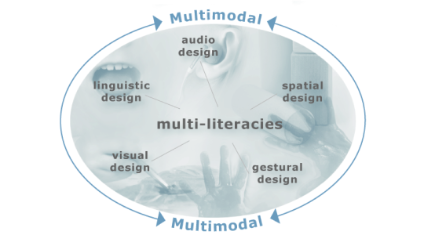 3. What is critical literacy?
As with all the words described here, it is impossible to provide a
precise definition of critical literacy that will be satisfactory to
everybody. Critical literacy may be thought about as an approach to the
study of language and texts that examines the relationship between
language, text, power, social groups, and social practices. Critical
literacy develops in students the capacity to understand how our meaning
making systems (including texts) contribute to representations of
ourselves and the world that are shaped by the exercise of power and
discourse. It gives students the capacity to criticise a text, to question a text's bias and validity, and to question the ideas a text may claim to be true. If you're not happy with this definition of critical literacy, I'm not surprised! 4. What is cultural studies?
Cultural studies is not the same as critical literacy. Robin Peel in
Chapter 4 of the text describes cultural studies as a 'set of practices'
related to the study of texts as artifacts of a culture and the
relationships of power, class, gender and race that traverse that
culture. Emerging in the 1960s and 1970s, cultural studies
broadened literacy criticism to include popular culture and everyday texts. Five
characteristics of cultural studies are:
What, then, does a cultural studies approach to English teaching look like? 5. What is the Australian Curriculum? The national curriculum of Australia, currently being implemented in the K-10 subject areas of: English, Maths, Science and History. 6. What is TPACK? Technological Pedagogical and Content Knowledge. This is a framework not just for tech-minded teachers. With a growing push for ALL teachers (yes, that includes you!) to integrate ICT and e-learning into their classrooms, TPACK is a framework developed to help us understand the effective integration of technology in the teaching of your content. The following video is provided by roycekimmons. Can you find other videos on the internet that give a clear explanation of TPACK?
7. For innovative examples of how to use multimedia for storytelling, visit Penguin's We Tell Stories website. Could you use similar activities or tasks in your English programs? There are plenty of websites that could be used to create stories (e.g. Google Maps, Animoto, Capzles...) 8. HERE is a PDF document that outlines the differences and similarities between the Australian Curriculum and the English K-10 Syllabus that is/has been used in WA prior to the implementation of the Australian Curriculum. Exciting bed-time reading! |
